Scottish Wedding Traditions: A Complete Guide for Modern Couples
· Traditions
Scotland has one of the richest wedding traditions of any country in the world. Many of these customs stretch back centuries; others are more recent inventions that have nonetheless become firmly embedded in the Scottish wedding vocabulary. The result is a tradition that feels both ancient and alive — couples can lean into as much or as little of it as they like, and even one or two well-chosen elements give a day a distinctly Scottish character.
Here is our guide to the traditions worth knowing about — what they are, where they came from, and how to weave them naturally into a modern wedding day.
Handfasting
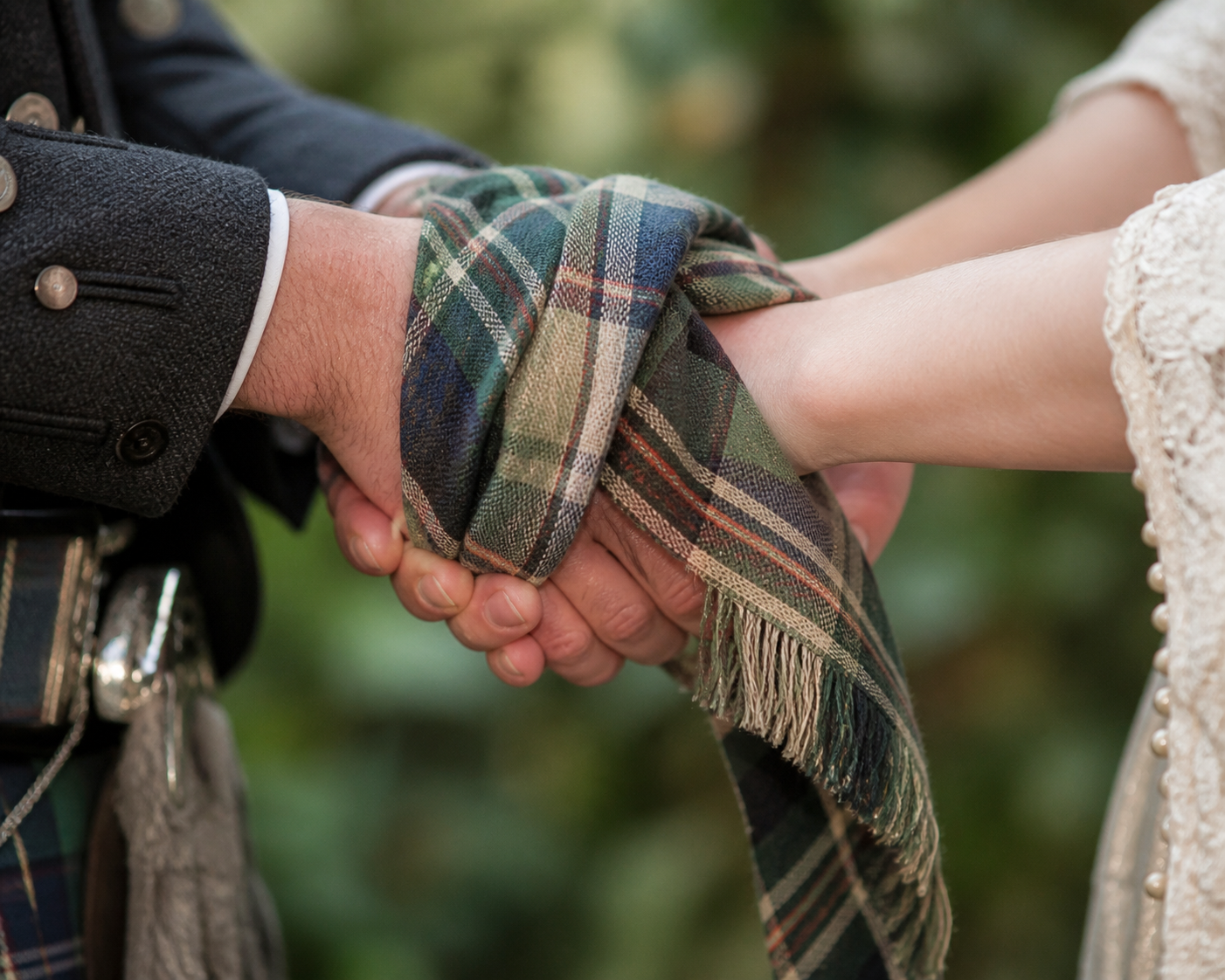
Perhaps the oldest and most poetic of all Scottish wedding customs, handfasting is a ritual in which the couple's hands are bound together with ribbon or cord during the ceremony — symbolising the binding of two lives. The phrase "tying the knot" derives directly from this practice. Handfasting was historically used as a form of betrothal or trial marriage in medieval Scotland, often when a priest could not be reached; today it is incorporated into civil and religious ceremonies as a beautiful symbolic gesture.
Your celebrant or registrar can incorporate a handfasting into almost any ceremony format. Many couples invite a parent, sibling or close friend to perform the binding, and the cords or ribbons themselves are often kept as a keepsake afterwards. Some couples use family tartan for the ribbons; others choose colours that have personal significance.
It is also the gesture that gave Handfast its name — we think it captures the spirit of a Scottish wedding directory better than anything else could.
The Quaich
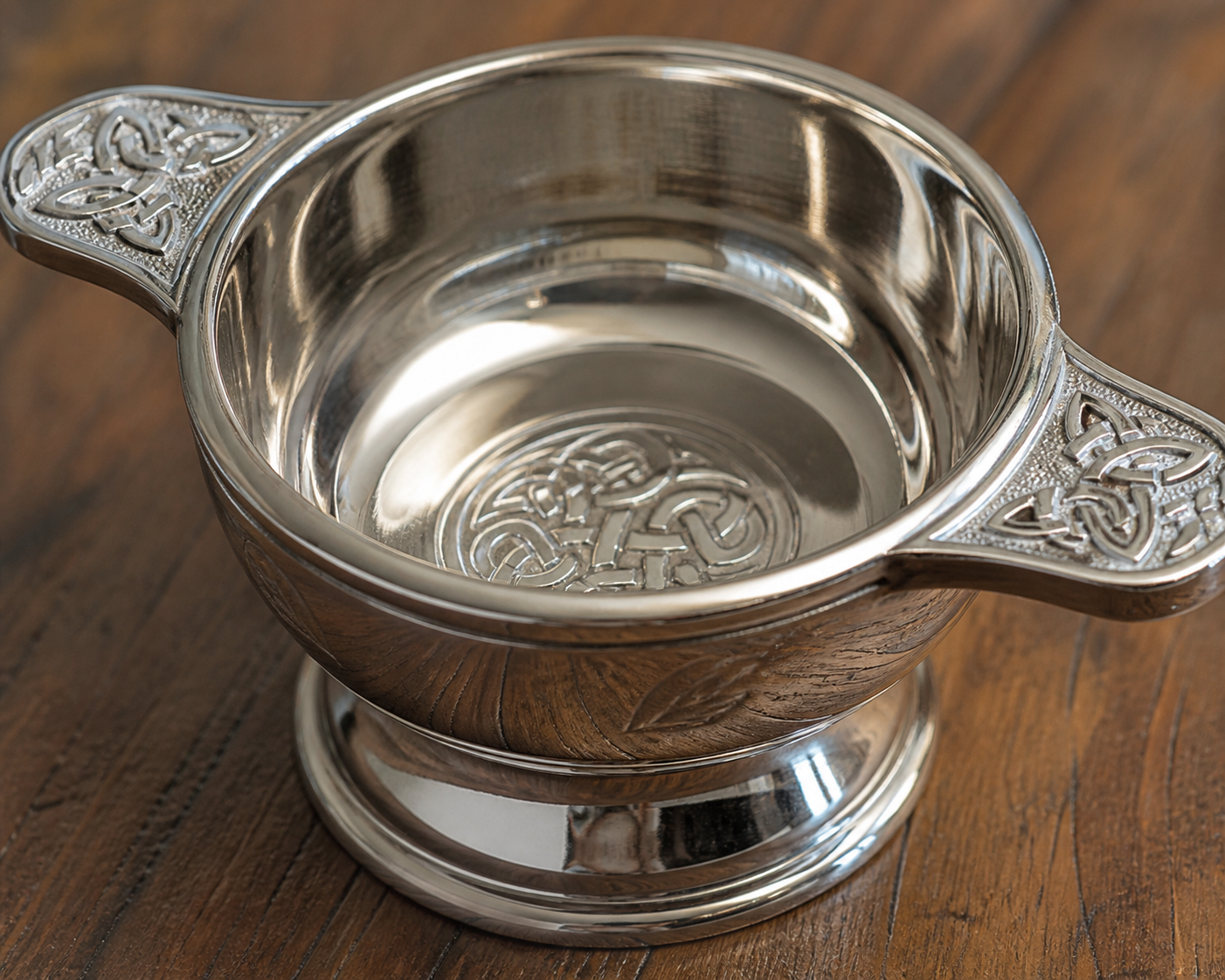
The quaich (pronounced "quake") is a traditional Scottish two-handled drinking cup, also known as the "cup of welcome" or "loving cup." In a wedding ceremony, the couple drinks from the same quaich — often filled with whisky — as a symbol of shared life and mutual trust. Many couples present a quaich to their parents as part of the ceremony, extending the symbolism to the joining of families. A personalised quaich, engraved with the couple's names and wedding date, makes a meaningful keepsake that can be passed down.
If neither of you drinks whisky, the quaich works equally well filled with anything from gin (Edinburgh has plenty of distilleries to choose from) to cold tea — the meaning is in the sharing, not the contents.
Highland Dress
Few sights are more striking than a wedding party in full Highland dress — kilt, Prince Charlie jacket, sporran, sgian-dubh and ghillie brogues. The kilt should be worn in the tartan of the groom's family clan if one exists; if not, a universal tartan such as the Black Watch or Royal Stewart is entirely acceptable, as are modern district tartans like Edinburgh's own.
Bridesmaids and female guests often incorporate tartan sashes or accessories to complement the look — traditionally pinned over the right shoulder if your family has a clan connection, over the left if you've married into one. Highland dress hire is widely available across Edinburgh; most outfitters offer measurement and fitting service well in advance of the wedding day.
A small detail worth knowing: the kilt is not worn with anything underneath in the strictest tradition, though that is increasingly a matter of personal preference rather than rule.
A Piper
The skirl of bagpipes is the sound of Scotland, and a piper at your wedding adds an unmistakable sense of occasion. There are several traditional moments where a piper appears: leading the wedding party into the ceremony, piping the couple from ceremony to reception, announcing the entrance to the wedding breakfast, and piping the couple away at the end of the evening. Many couples also have the piper play during drinks reception photographs.
Edinburgh has a wealth of professional pipers available for hire, many of whom can play a broader repertoire than you might expect — including modern pop tunes arranged for pipes, which can be a charming touch for a "first dance pipe-in." Discuss tune choices with your piper a few weeks before; "Highland Cathedral," "Mairi's Wedding," and "Scotland the Brave" are perennial favourites.
The Ceilidh
Many Scottish weddings include a ceilidh — a traditional Scottish social dance with live band — usually after the wedding breakfast and speeches. A ceilidh caller guides guests through the dances, which means no experience is necessary and the energy in the room is invariably electric. The Strip the Willow, the Dashing White Sergeant, the Gay Gordons and the Eightsome Reel are perennial favourites.
A ceilidh band typically plays for two to three hours and can usually accommodate a mix of ceilidh and more contemporary music throughout the evening. Smaller bands of three or four work well for guest counts under 80; for larger weddings, a five- or six-piece band fills the room better. If your venue has dance-floor sound restrictions or a curfew, confirm these with both the venue and the band well before the day.
The Wedding Scramble
A lovely older tradition, the wedding "scramble" or "scoor-oot" involves the bride throwing handfuls of coins to children gathered outside the ceremony venue. Less common today than it once was, it survives in some communities — particularly in rural and small-town weddings.
The Quaich Procession
In some weddings the quaich is passed first between the couple, then around their immediate families, and occasionally around all the guests. This expanded version is well suited to small weddings where it can be done meaningfully without taking too long. For larger weddings, keeping the quaich exchange to the couple and parents preserves the intimacy of the gesture.
Selecting Your Florals
Scottish wedding florals often draw on native plants — heather, thistle, rosemary and Scottish wildflowers — and pair beautifully with both traditional and contemporary venues. A florist who knows the Edinburgh seasons can advise on what's at its best for your wedding date. You can browse Edinburgh wedding florists on Handfast for inspiration.
Incorporating Tradition Thoughtfully
The best Edinburgh weddings find a natural balance between tradition and the couple's own personality. You do not need to include every custom listed here — even one or two well-chosen traditions can give your day a distinctly Scottish character. Talk to your celebrant, venue coordinator and suppliers about which traditions resonate with you and how they can be incorporated smoothly.
A few questions worth asking yourselves: which traditions feel meaningful rather than decorative? Which ones connect to your family history or to the city you are getting married in? And which suppliers in your wedding (a piper, a celebrant, a Highland dress outfitter) can help bring those choices to life?
For inspiration on where to host a traditional Scottish wedding, our guides to the most spectacular castle wedding venues and the best outdoor wedding venues are good starting points.